
 Light Tank
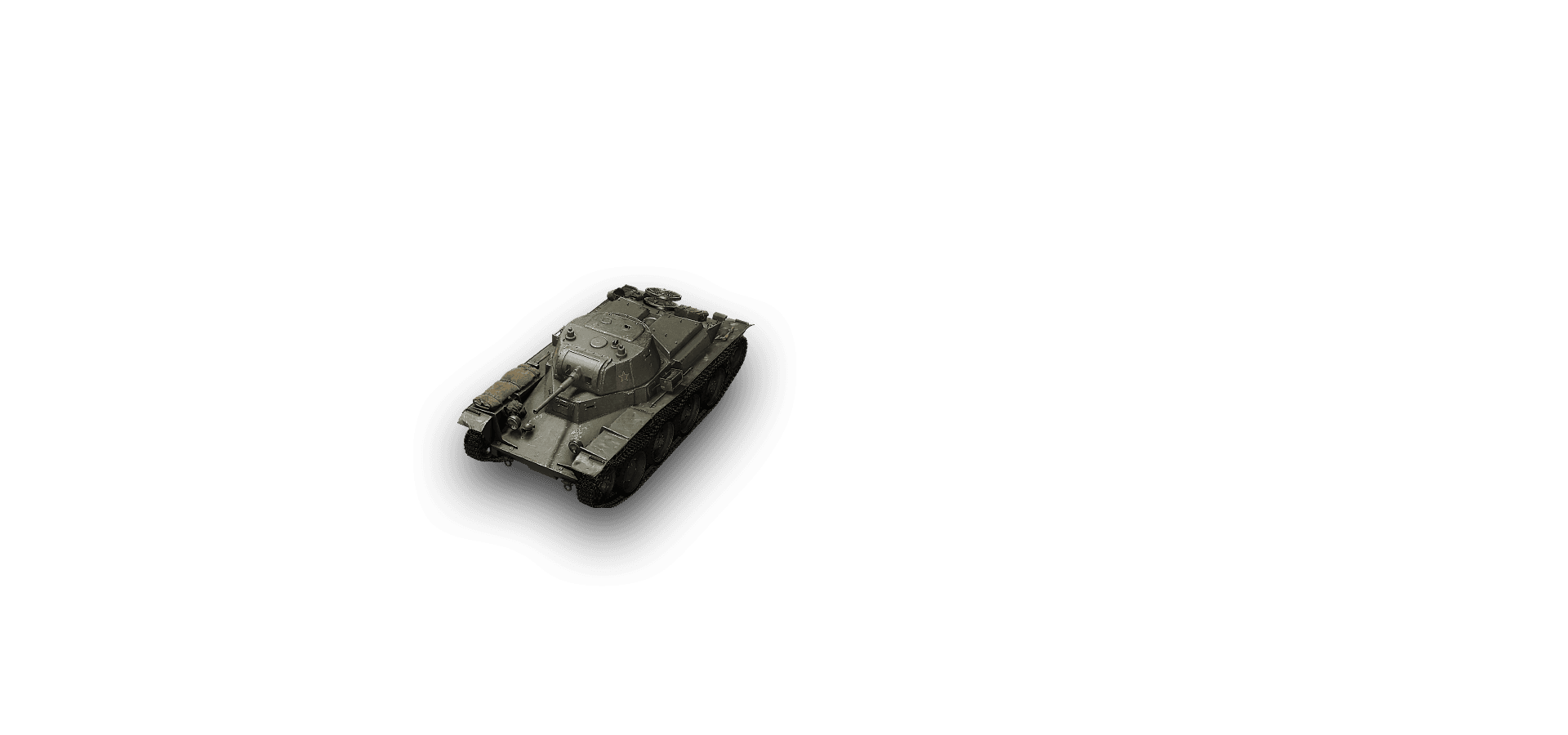
T-46
World of Tanks EU statistics for the III U.S.S.R. light tank T-46.
Characteristics of the T-46
Firepower
- Damage
- 47hp
- … vs modules
- 61hp
- Penetration
- 51mm
- … at 500m
- 38mm
- DPM
- 1,226
- Reload
- 2.30s
- Rate of fire
- 26.09/min
- Aim time
- 2.30s
- Dispersion
- 0.460m
- … moving
- 0.280
- … hull traverse
- 0.280
- … turret traverse
- 0.160
- … after firing
- 4.00×
- … gun damaged
- 2.00×
- Shell velocity
- 757m/s
- Max range
- 720m
- Caliber
- 45mm
- … potential damage
- 9,400hp
- … full ammo
- 2,800
Mobility
- Top speed
- 58km/h
- Reverse speed
- 20km/h
- Engine power
- 300hp
- Power/weight
- 21.3hp/t
- Hull traverse
- 52.0°/s
- Turret traverse
- 44.0°/s
- … hard
- 1.10
- … medium
- 1.50
- … soft
- 2.30
- … hard
- 58.0km/h
- … medium
- 51.9km/h
- … soft
- 33.9km/h
- … hard
- 52.0°/s
- … medium
- 38.1°/s
- … soft
- 24.9°/s
Survivability
- Hit points
- 425hp
- … front
- 15mm
- … side
- 15mm
- … rear
- 15mm
- … front
- 30mm
- … side
- 15mm
- … rear
- 15mm
- Track armor
- 10mm
- Fire chance
- 15.0%
- Track repair time
- 12.03s
- … ammo rack
- 90 / 60hp
- … track
- 60 / 45hp
- … engine
- 93 / 45hp
- … fuel tank
- 100 / 40hp
- … turret ring
- 70 / 35hp
- … viewport
- 50 / 25hp
Spotting & other
- View range
- 260m
- Signal range
- 300m
- … stationary
- 16.6%
- … moving
- 12.4%
- Weight
- 14.1t
Ammunition
Equipment
Consumables
Directives
Crew Skills

 Commander / Radio Operator / Loader
 Driver
 Gunner
Modules of the T-46


Historical reference of the T-46
Developed under the program for improving the maneuverability of the T-26 light tank through redesigning its chassis to a wheeled caterpillar type. The prototype was built in 1935. The vehicle saw service on February 29, 1936 after a series of modifications. At least four vehicles from the experimental batch underwent trials in 1937, but the production was discontinued due to transmission faults and high cost. The manufactured vehicles were used during the Winter War and World War II.
Videos of the T-46
No community video for the T-46 yet. Suggest one and it shows up here once a moderator has looked at it.
Tanks close to the T-46
Same standing among their own tier- 85%match
 Pz.Kpfw. IV Ausf. DIV
Closest on survivability and playstyle, furthest on gun handling
- 84%matchPz.Kpfw. IV Ausf. AIII
Closest on survivability and mobility, furthest on gun handling
- 83%match
 T-116III
Closest on mobility and survivability, furthest on firepower
- 83%matchT-28IV
Closest on playstyle and mobility, furthest on firepower
- 82%match
 T1E6II
Closest on playstyle and mobility, furthest on concealment
- 82%matchBT-7 artilleryIII
Closest on survivability and concealment, furthest on mobility