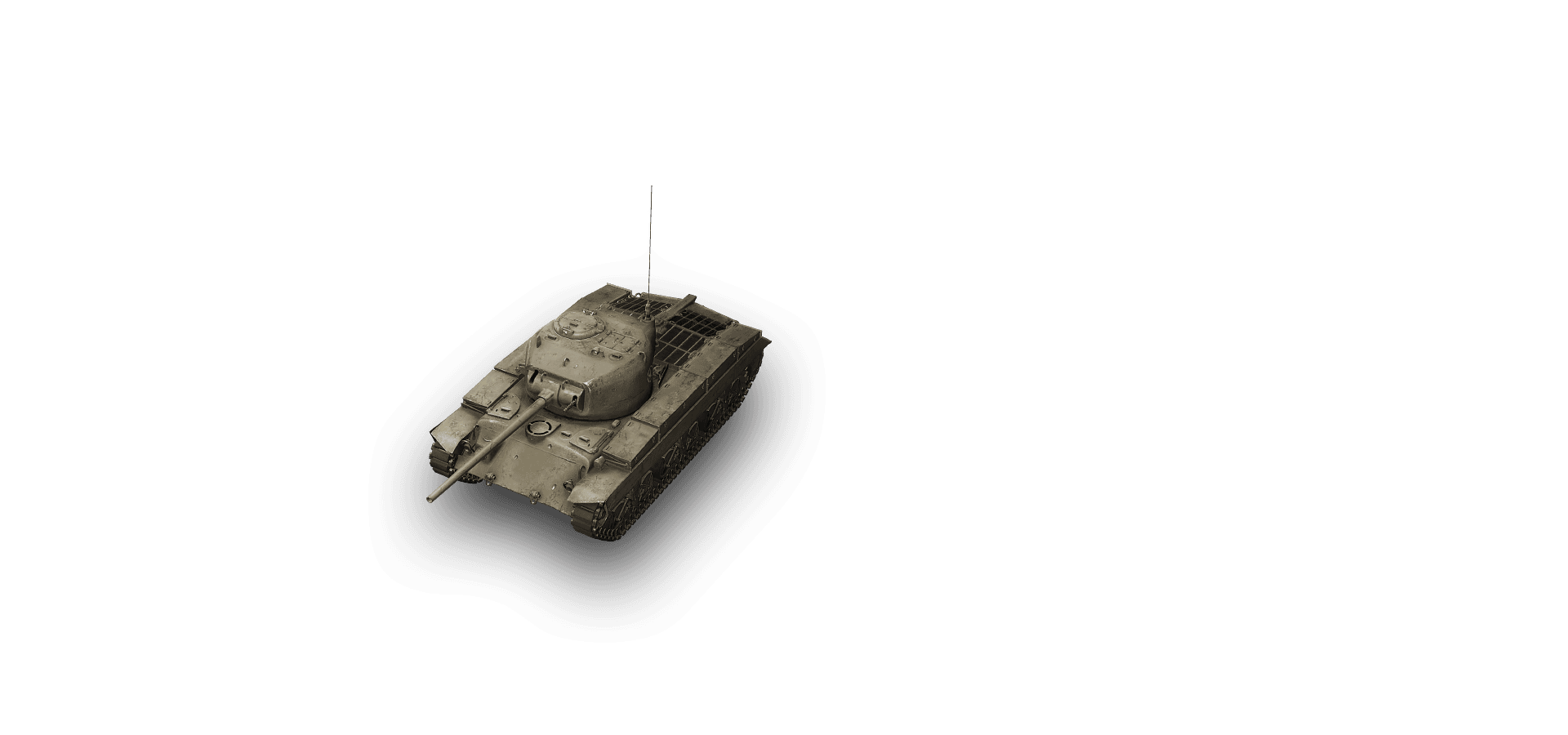

 Light TankVersatilePremium
A46
World of Tanks EU statistics for the VI U.K. light tank A46.
Characteristics of the A46
Firepower
- Damage
- 105hp
- … vs modules
- 105hp
- Penetration
- 105mm
- … at 500m
- 88mm
- DPM
- 1,500
- Reload
- 4.20s
- Rate of fire
- 14.29/min
- Aim time
- 2.00s
- Dispersion
- 0.450m
- … moving
- 0.150
- … hull traverse
- 0.150
- … turret traverse
- 0.100
- … after firing
- 3.50×
- … gun damaged
- 2.00×
- Shell velocity
- 785m/s
- Max range
- 720m
- Caliber
- 76mm
- … potential damage
- 5,250hp
- … full ammo
- 4,750
Mobility
- Top speed
- 60km/h
- Reverse speed
- 20km/h
- Engine power
- 350hp
- Power/weight
- 22.2hp/t
- Hull traverse
- 55.0°/s
- Turret traverse
- 52.0°/s
- … hard
- 0.80
- … medium
- 0.90
- … soft
- 1.50
- … hard
- 60.0km/h
- … medium
- 60.0km/h
- … soft
- 54.1km/h
- … hard
- 55.0°/s
- … medium
- 48.9°/s
- … soft
- 29.3°/s
Survivability
- Hit points
- 580hp
- … front
- 32mm
- … side
- 20mm
- … rear
- 16mm
- … front
- 35mm
- … side
- 20mm
- … rear
- 20mm
- Track armor
- 20mm
- Fire chance
- 20.0%
- Track repair time
- 12.03s
- … ammo rack
- 180 / 120hp
- … track
- 120 / 90hp
- … engine
- 234 / 123hp
- … fuel tank
- 150 / 50hp
- … turret ring
- 120 / 60hp
- … viewport
- 80 / 40hp
Spotting & other
- View range
- 370m
- Signal range
- 450m
- … stationary
- 18.0%
- … moving
- 18.0%
- Weight
- 15.8t
Ammunition
Equipment
Consumables
Directives
Field Modifications
Crew Skills

 Commander / Radio Operator
 Gunner
 Driver
 Loader
Modules of the A46


Historical reference of the A46
Development was started in December 1943. Mass production was planned to launch in 1945. This vehicle was intended to replace the American M3/M5 Stuart (and later the M24 Chaffee) used by reconnaissance units of armored regiments. The agreement was concluded with the Vickers company. Some technical solutions that were trialed on the Tetrarch and Harry Hopkins vehicles were applied to the development of this vehicle. A wooden prototype was built. However, after the end of WWII, the tactical and technical requirements were changed. Further development was continued under the FV300 program.
Videos of the A46
No community video for the A46 yet. Suggest one and it shows up here once a moderator has looked at it.
Tanks close to the A46
Same standing among their own tier- 89%match
 M24E2 Super ChaffeeVI
Closest on playstyle and survivability, furthest on concealment
- 88%match
 Type 62VII
Closest on mobility and playstyle, furthest on gun handling
- 88%match59-16VI
Closest on mobility and playstyle, furthest on gun handling
- 88%matchT21VI
Closest on mobility and survivability, furthest on gun handling
- 88%matchType 64VI
Closest on survivability and mobility, furthest on firepower
- 88%match
 GSR 3301 SetterVII
Closest on playstyle and concealment, furthest on gun handling