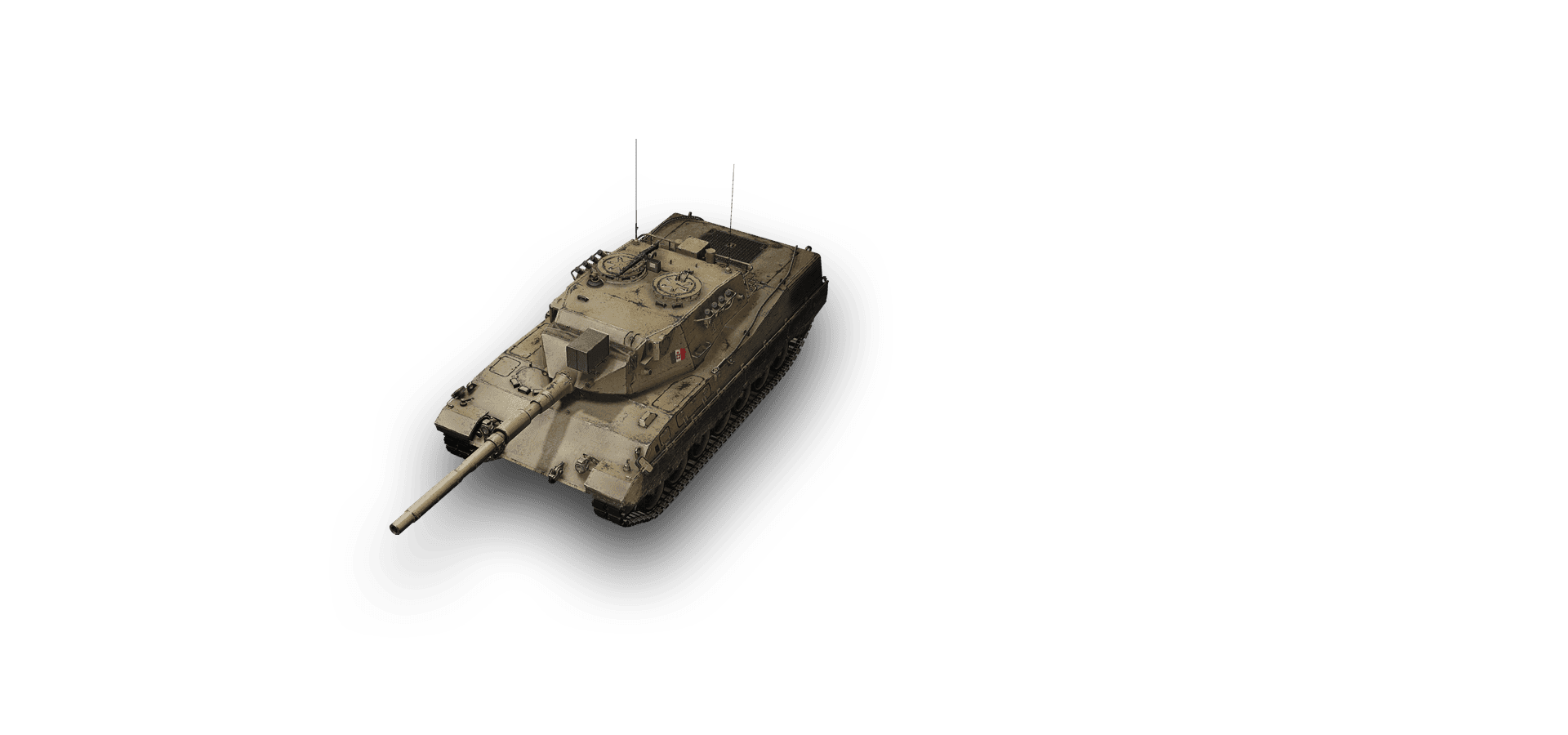

Lion characteristics
Firepower
- Damage
- 420hp
- Penetration
- 258mm
- DPM
- 3,305
- Reload
- 17.00s
- Rate of fire
- 7.87/min
- Aim time
- 2.70s
- Accuracy
- 0.330m
- Dispersion moving
- 0.200
- Shell velocity
- 1,080m/s
- Caliber
- 105mm
- Gun depression
- 20°
- Gun elevation
- 9°
Mobility
- Top speed
- 60km/h
- Reverse speed
- 15km/h
- Engine power
- 830hp
- Power/weight
- 19.3hp/t
- Hull traverse
- 45.0°/s
- Turret traverse
- 52.0°/s
- Hard terrain
- 0.80
- Medium terrain
- 0.90
- Soft terrain
- 1.80
Survivability
- Hit points
- 1,480hp
- Hull armor (front)
- 70mm
- Turret armor (front)
- 180mm
- Fire chance
- 0%
- Ammo rack HP
- 260hp
- Track HP
- 250hp
Spotting & other
- View range
- 400m
- Signal range
- 750m
- Camo (still)
- 0.3%
- Camo (moving)
- 0.2%
- Weight
- 43.0t
Lion historical reference
After the war, Italy set a course for the manufacture of licensed products, and successfully mastered the production of the Leopard 1 and M60 Patton. At the same time, the development of their own combat vehicles continued, although their designs were largely based on foreign creations. The country's debut model was designated the Lion. Despite its similarities with the Leopard 1 and Leopard 1A3, the vehicles differed significantly, especially in the turret. The first trials of the tank were conducted in 1977, but the vehicle never saw mass production. After the release of the more advanced Leopard 2 in 1978, the Lion was rendered obsolete. Nevertheless, it was considered a milestone vehicle that provided immense experience and expertise in the creation of other armored vehicles.