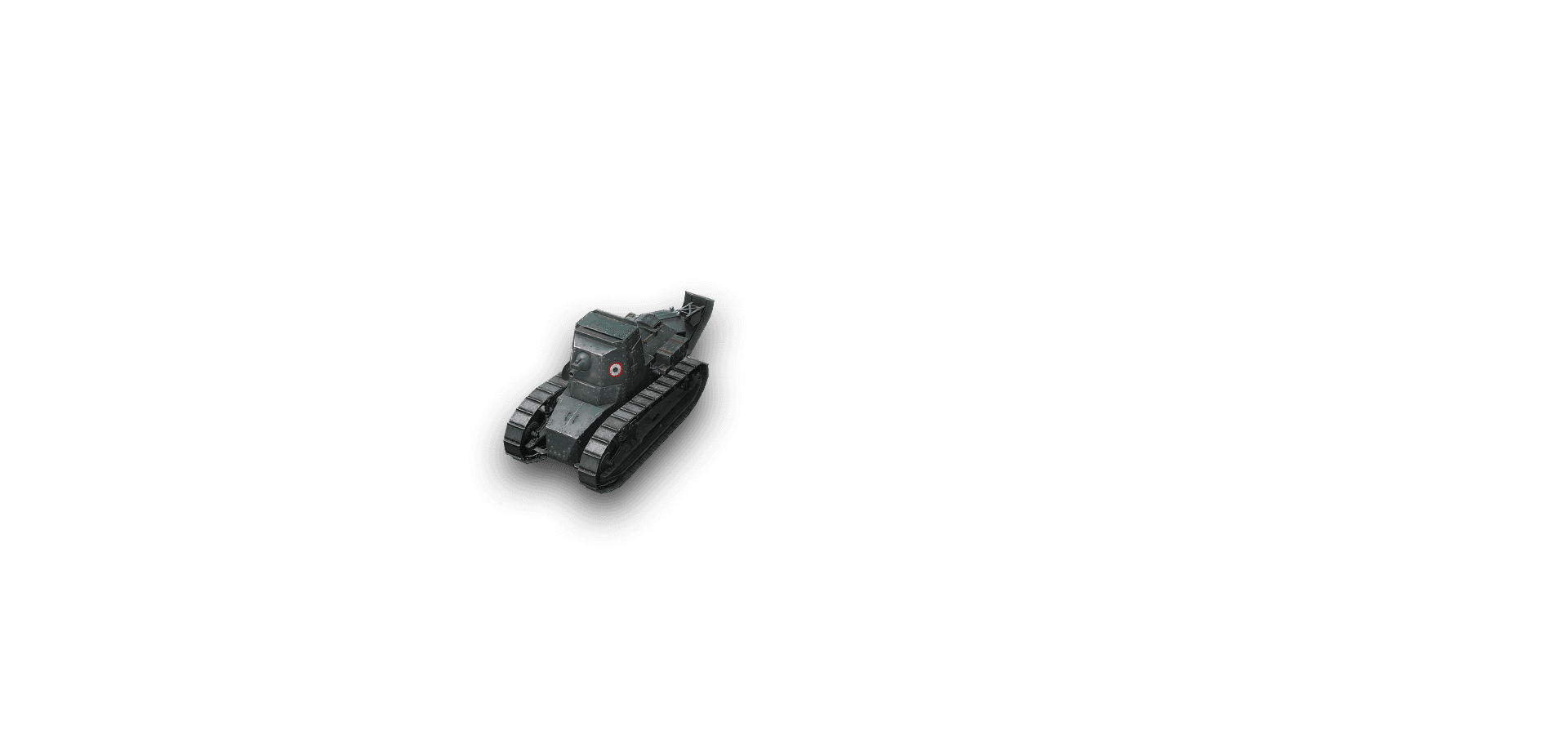

Renault FT 75 BS characteristics
Firepower
- Damage
- 165hp
- Penetration
- 19mm
- DPM
- 1,269
- Reload
- 7.80s
- Rate of fire
- 7.69/min
- Aim time
- 4.50s
- Accuracy
- 0.770m
- Dispersion moving
- 0.300
- Shell velocity
- 270m/s
- Caliber
- 75mm
- Gun depression
- 45°
- Gun elevation
- 7°
Mobility
- Top speed
- 19km/h
- Reverse speed
- 6km/h
- Engine power
- 100hp
- Power/weight
- 13.7hp/t
- Hull traverse
- 14.0°/s
- Turret traverse
- 18.0°/s
- Hard terrain
- 1.20
- Medium terrain
- 1.40
- Soft terrain
- 2.30
Survivability
- Hit points
- 128hp
- Hull armor (front)
- 16mm
- Turret armor (front)
- —
- Fire chance
- 0%
- Ammo rack HP
- 50hp
- Track HP
- 50hp
Spotting & other
- View range
- 250m
- Signal range
- 360m
- Camo (still)
- 0.2%
- Camo (moving)
- 0.1%
- Weight
- 7.3t
Renault FT 75 BS historical reference
An SPG with the 75-mm short-barrel S-type Blockhaus Schneider howitzer installed in the armored cabin. It was larger than previous guns, which increased the vehicle mass to 7.3 tons and cut its ammunition to 30 shells. High command saw value in the project and placed an order for 970 vehicles. By the end of World War I, a total of 39 vehicles were manufactured; after that, production was discontinued. There is no reliable information about participation of this SPG during the 1940s, but some vehicles took part in battles in North Africa. Two SPGs were captured by the Allies (U.S.A., U.K., France) during Operation Torch.