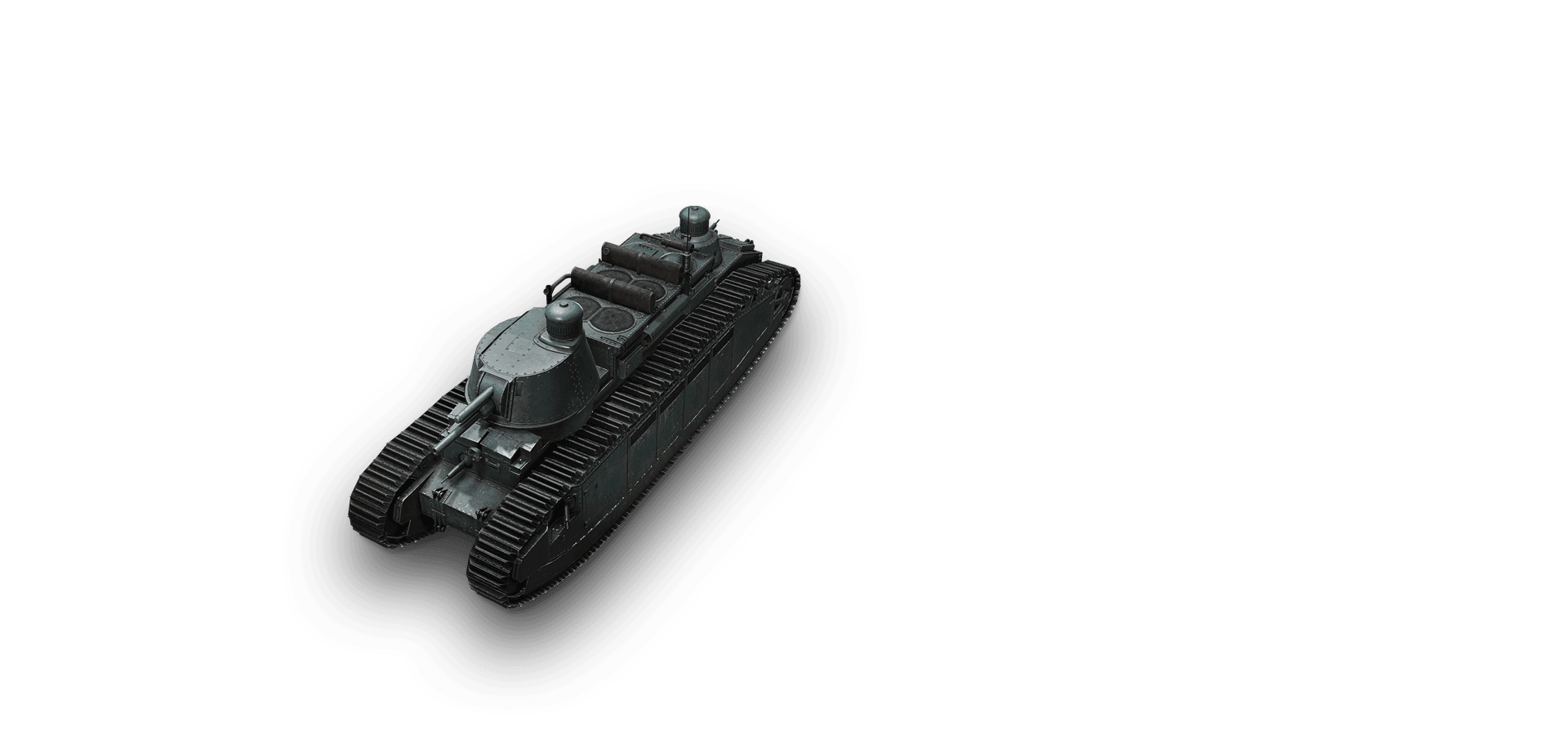

FCM 2C characteristics
Firepower
- Damage
- 110hp
- Penetration
- 62mm
- DPM
- 1,048
- Reload
- 6.30s
- Rate of fire
- 9.52/min
- Aim time
- 2.30s
- Accuracy
- 0.420m
- Dispersion moving
- 0.300
- Shell velocity
- 550m/s
- Caliber
- 75mm
- Gun depression
- 20°
- Gun elevation
- 20°
Mobility
- Top speed
- 15km/h
- Reverse speed
- 15km/h
- Engine power
- 500hp
- Power/weight
- 7.1hp/t
- Hull traverse
- 20.0°/s
- Turret traverse
- 24.0°/s
- Hard terrain
- 1.00
- Medium terrain
- 1.10
- Soft terrain
- 1.90
Survivability
- Hit points
- 560hp
- Hull armor (front)
- 45mm
- Turret armor (front)
- 35mm
- Fire chance
- 0%
- Ammo rack HP
- 110hp
- Track HP
- 75hp
Spotting & other
- View range
- 320m
- Signal range
- 310m
- Camo (still)
- 0.0%
- Camo (moving)
- 0.0%
- Weight
- 70.0t
FCM 2C historical reference
Development of the FCM 2C heavy breakthrough tank began at the end of 1916, with the vehicle intended to replace the poorly designed Saint-Chamond and Schneider CA1 assault tanks. An order was placed for a total of 700 vehicles that were supposed to be produced in time for a new advance scheduled for the spring of 1919. However, the order was canceled due to the end of the war. As a result, the army received just 10 FCM 2C tanks from 1918 through 1922. Each vehicle had its own designation.