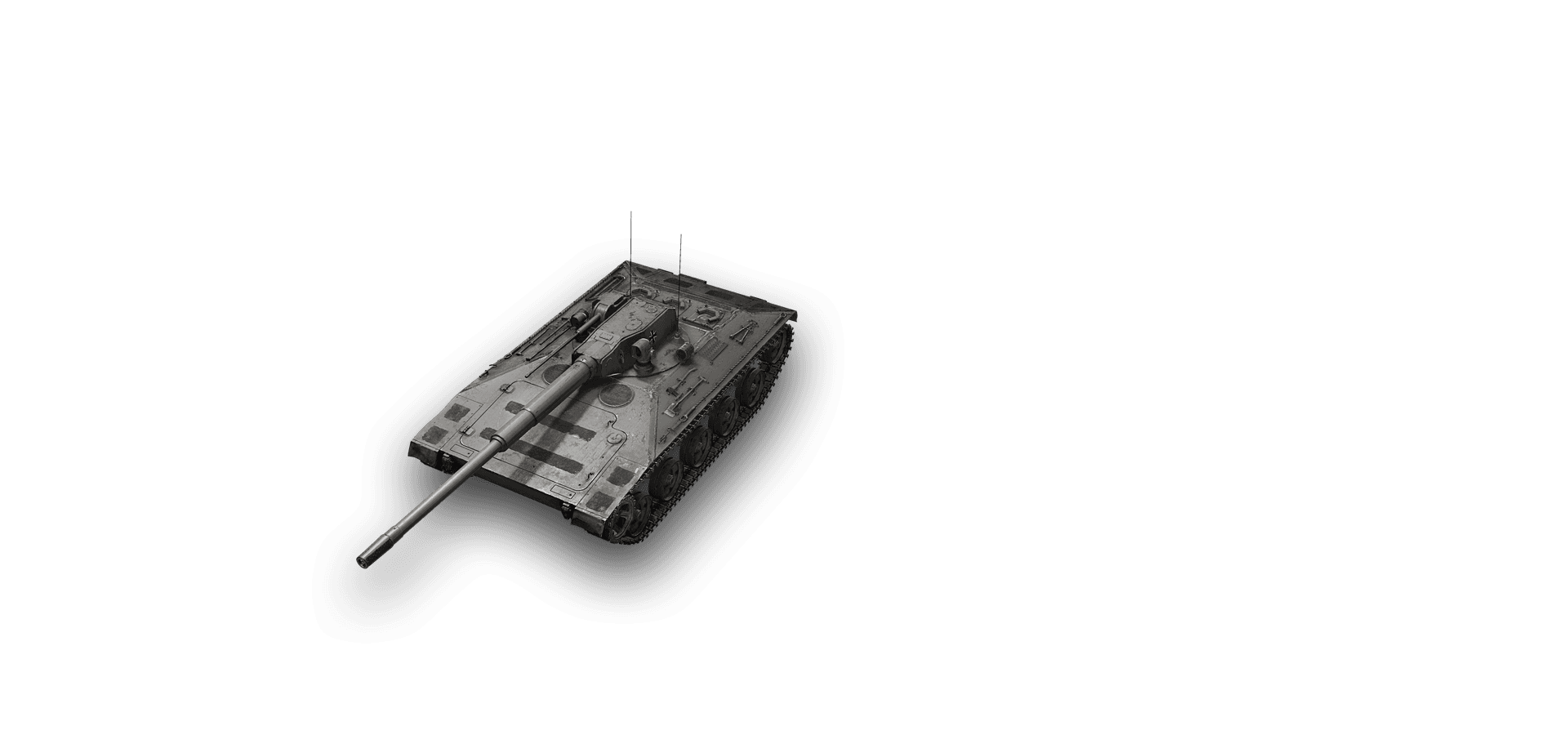

Leichter Kpz. 70 (K) characteristics
Firepower
- Damage
- 240hp
- Penetration
- 190mm
- DPM
- 1,694
- Reload
- 8.50s
- Rate of fire
- 7.06/min
- Aim time
- 2.10s
- Accuracy
- 0.330m
- Dispersion moving
- 0.120
- Shell velocity
- 1,000m/s
- Caliber
- 90mm
- Gun depression
- 20°
- Gun elevation
- 10°
Mobility
- Top speed
- 60km/h
- Reverse speed
- 20km/h
- Engine power
- 700hp
- Power/weight
- 28.0hp/t
- Hull traverse
- 50.0°/s
- Turret traverse
- 40.0°/s
- Hard terrain
- 0.60
- Medium terrain
- 0.70
- Soft terrain
- 1.20
Survivability
- Hit points
- 920hp
- Hull armor (front)
- 30mm
- Turret armor (front)
- 40mm
- Fire chance
- 0%
- Ammo rack HP
- 200hp
- Track HP
- 220hp
Spotting & other
- View range
- 380m
- Signal range
- 750m
- Camo (still)
- 0.3%
- Camo (moving)
- 0.3%
- Weight
- 25.0t
Leichter Kpz. 70 (K) historical reference
In 1970, Krupp GmbH investigated the possibility of creating a vehicle with a crew of one to three members, or even a remote-controlled tank without a crew. The basic prototype was supposed to feature an adjustable hydropneumatic suspension with very long rollers' travel and high specific power. The main armament was a gun with two-plane stabilization. Using a lifting roof over the gun breech provided a depression angle of -10 degrees. The crew was located in the rear and controlled the vehicle using cameras and highly-automated remote systems. The vehicle's excellent mobility was intended to be its main form of protection. Work on the project was discontinued at the modeling and blueprint stage.