
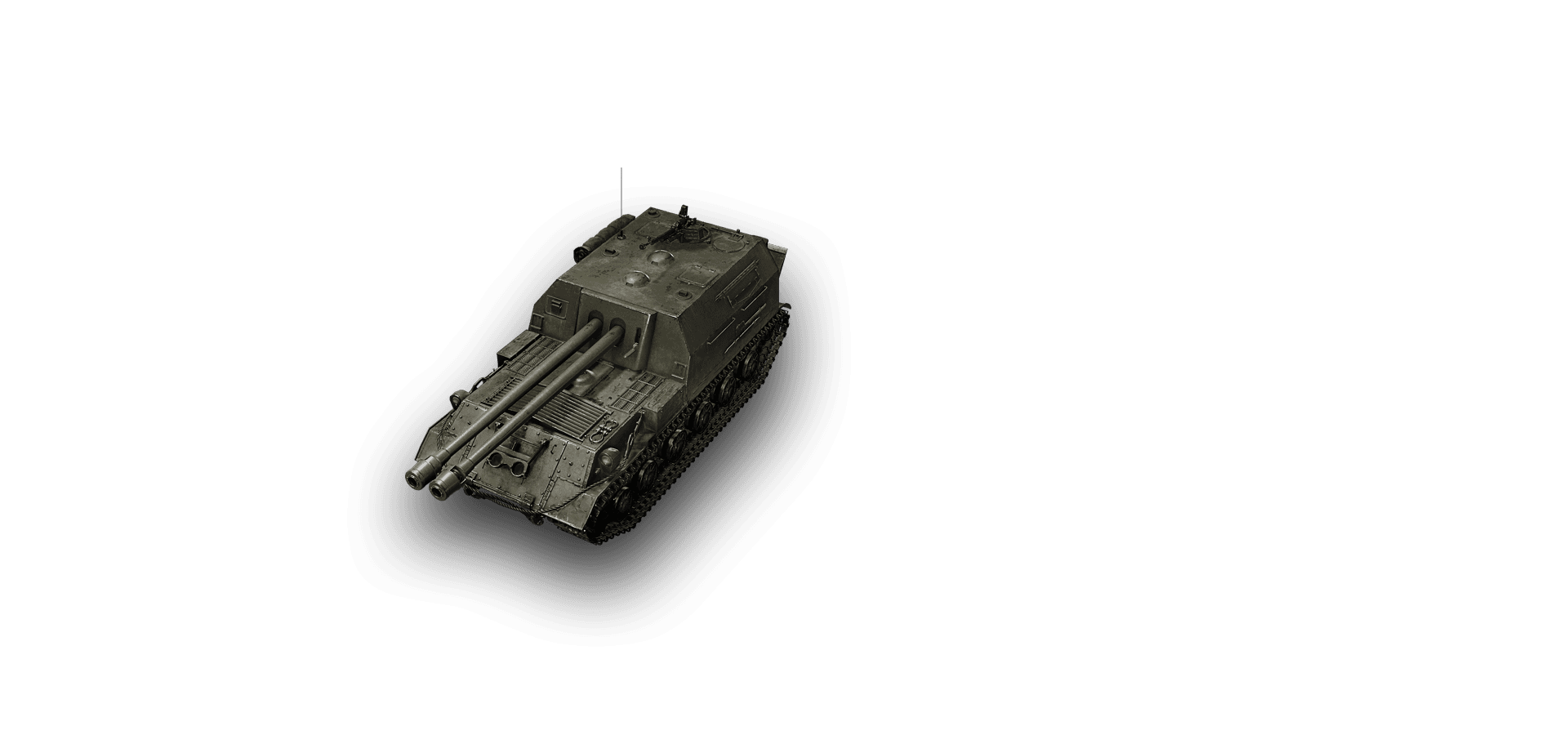

ISU-122-2 characteristics
Firepower
- Damage
- 390hp
- Penetration
- 258mm
- DPM
- 2,340
- Reload
- 10.00s
- Rate of fire
- 6.00/min
- Aim time
- 2.00s
- Accuracy
- 0.370m
- Dispersion moving
- 0.150
- Shell velocity
- 1,100m/s
- Caliber
- 122mm
- Gun depression
- 15°
- Gun elevation
- 5°
Mobility
- Top speed
- 40km/h
- Reverse speed
- 20km/h
- Engine power
- 750hp
- Power/weight
- 15.0hp/t
- Hull traverse
- 30.0°/s
- Turret traverse
- 18.0°/s
- Hard terrain
- 1.00
- Medium terrain
- 1.10
- Soft terrain
- 1.90
Survivability
- Hit points
- 1,040hp
- Hull armor (front)
- 190mm
- Turret armor (front)
- —
- Fire chance
- 0%
- Ammo rack HP
- 200hp
- Track HP
- 200hp
Spotting & other
- View range
- 370m
- Signal range
- 720m
- Camo (still)
- 0.2%
- Camo (moving)
- 0.1%
- Weight
- 50.0t
ISU-122-2 historical reference
At the beginning of the World War II, Soviet tank construction returned to multi-barreled tanks. The most famous combat vehicle built under this concept was the KV-7 assault SPG. In early 1945, Experimental Plant #100 (Leningrad branch) began work on the development of a double-barrel SPG based on the ISU. The project, tentatively named the ISU-122-2, was supposed to be a typical "self-propelled gun carriage" with twin 122 mm D-25S guns. The vehicle was never built, but the designers' ideas had a direct influence on further Leningrad SPG projects.