
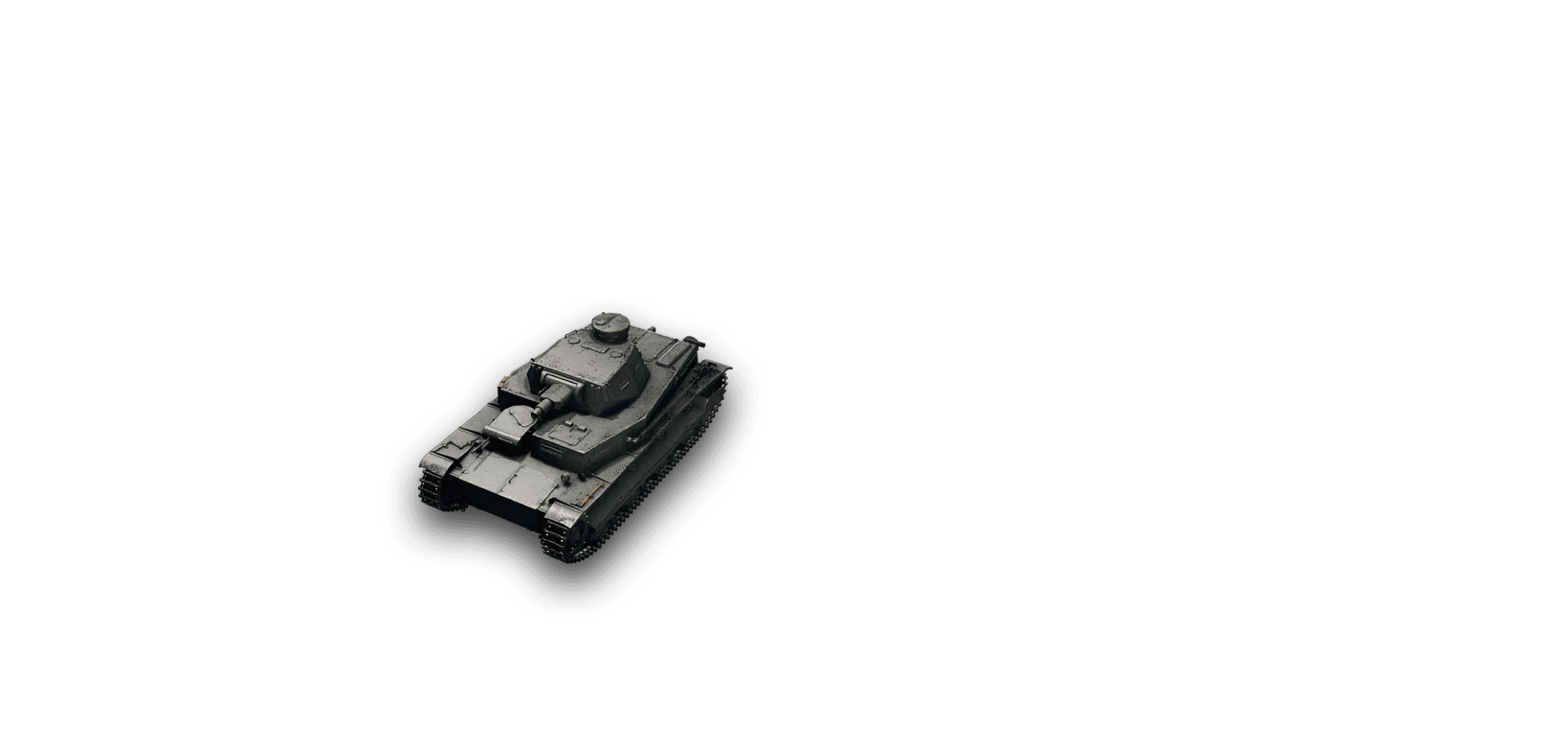
 Medium tankPremium
Rheinmetall Begleitwagen
World of Tanks ASIA statistics for the III GERMANY medium tank Rheinmetall Begleitwagen.
Rheinmetall Begleitwagen characteristics
Firepower
- Damage
- 85hp
- … vs modules
- 100hp
- Penetration
- 47mm
- … at 500m
- 40mm
- DPM
- 1,500
- Reload
- 3.40s
- Rate of fire
- 17.65/min
- Aim time
- 2.10s
- Dispersion
- 0.500m
- … moving
- 0.180
- … hull traverse
- 0.180
- … turret traverse
- 0.140
- … after firing
- 4.00×
- … gun damaged
- 2.00×
- Shell velocity
- 385m/s
- Max range
- 720m
- Caliber
- 75mm
- … potential damage
- 10,200hp
- … full ammo
- 2,520
Mobility
- Top speed
- 32km/h
- Reverse speed
- 15km/h
- Engine power
- 300hp
- Power/weight
- 16.2hp/t
- Hull traverse
- 38.0°/s
- Turret traverse
- 36.0°/s
- … hard
- 1.00
- … medium
- 1.20
- … soft
- 2.00
- … hard
- 32.0km/h
- … medium
- 32.0km/h
- … soft
- 29.7km/h
- … hard
- 38.0°/s
- … medium
- 31.7°/s
- … soft
- 19.0°/s
Survivability
- Hit points
- 600hp
- … front
- 30mm
- … side
- 20mm
- … rear
- 15mm
- … front
- 30mm
- … side
- 20mm
- … rear
- 15mm
- Track armor
- 10mm
- Fire chance
- 20.0%
- Track repair time
- 11.85s
- … ammo rack
- 110 / 83hp
- … track
- 75 / 56hp
- … engine
- 100 / 50hp
- … fuel tank
- 125 / 50hp
- … turret ring
- 80 / 40hp
- … viewport
- 50 / 25hp
Spotting & other
- View range
- 330m
- Signal range
- 310m
- … stationary
- 16.1%
- … moving
- 12.1%
- Weight
- 18.5t
Ammunition
Equipment
Consumables
Directives
Crew Skills

 Commander
 Gunner
 Driver
 Radio Operator
 Loader
 Loader
Rheinmetall Begleitwagen modules


Rheinmetall Begleitwagen historical reference
In the second half of 1934, the Germans started developing a tank designated as the Verbesserten Nb.Fz. The Rheinmetall company was responsible for its design. The vehicle was supposed to weigh 17-18 tons. Its armament consisted of a short-barreled 75 mm gun and a coaxial machine gun. Another machine gun was placed on a small turret at the front of the hull. Higher-density configuration with the transmission in the front helped dramatically reduce the hull length. There were also plans to use a special V-shaped 10-liter 12-cylinder Maybach HL 100 TR engine with 300 h.p. of power. Rheinmetall produced a life-size wooden mockup, and later a chassis out of construction steel. Many improvements were made to the latter, but it did not become the base for the mass-produced tank.
Rheinmetall Begleitwagen videos
No community video for the Rheinmetall Begleitwagen yet. Suggest one and it shows up here once a moderator has looked at it.